 HSE IPAA




Audit Engagement
Together with partner audit firms that are members of an SRO of auditors, we audit financial statements, the internal control system and key business risks. The audit report is issued by the partner audit firm.
 Audit under an agreed plan
 Auditors from partner firms that are SRO members
 Audit report from the partner audit firm (Federal Law No. 307-FZ)

0
When You Need an Audit
Audits are not conducted only when the law requires them. An audit is useful whenever the owner needs to know the real state of the company's accounting and finances.

Prepare for a tax audit

Assess the state of financial management

Review customer relationship management
What You Receive After the Audit
 An audit report from the partner audit firm
A report on identified issues and ways to resolve them
A management letter with recommendations
A company risk map
A list of correcting entries with explanations
A review of tax matters
An assessment of the internal control system
Why We Are Easy to Work With
We conduct audits together with partner audit firms that are members of an SRO of auditors, and we also train auditors.

Professional expertise
Audits are performed by auditors from partner audit firms that are members of an SRO of auditors.

Independent assessment
We provide objective conclusions on the state of accounting and financial statements.

Risk identification
We identify financial, tax and operational risks before they lead to losses.

Practical recommendations
We propose specific measures to remedy the violations identified.

Confidentiality
We protect the client's documents and information.

Clear results
We deliver a structured report with conclusions and priorities.
What Is Needed to Start the Audit
If the key data is gathered in advance, preparation will take minimal time.

Access to documents
Accounting registers and source documents

Financial statements
Statements for the period under audit

Contact person
An employee to liaise with the audit team

Agreed timeline
An approved plan and audit stages
Who an Audit Is For
Companies facing a statutory audit
Businesses preparing for a tax audit
Owners when management changes
Companies with outside investors
Organizations ahead of a transaction or a loan
Stages of an Audit
The audit goes through several consecutive stages, from analyzing the company's operations to reviewing the results together with management.

8 stages
The audit follows a clear plan agreed in advance.

Risk map
We identify areas that require constant monitoring.

Final meeting
We discuss the results and solutions with management.
- a detailed analysis of operations and identification of areas where failures and violations are likely
- agreeing on stages and drawing up a working audit plan
- assessment of market conditions and factors of business and audit risk
- reviewing internal audit reports to focus on the most important areas
- preparing a company risk map across key areas
- performing all planned and agreed audit activities
- addressing audit risks and financial statement adjustments, audit report from the partner audit firm
- discussing the financial statements, the management letter and the list of correcting entries
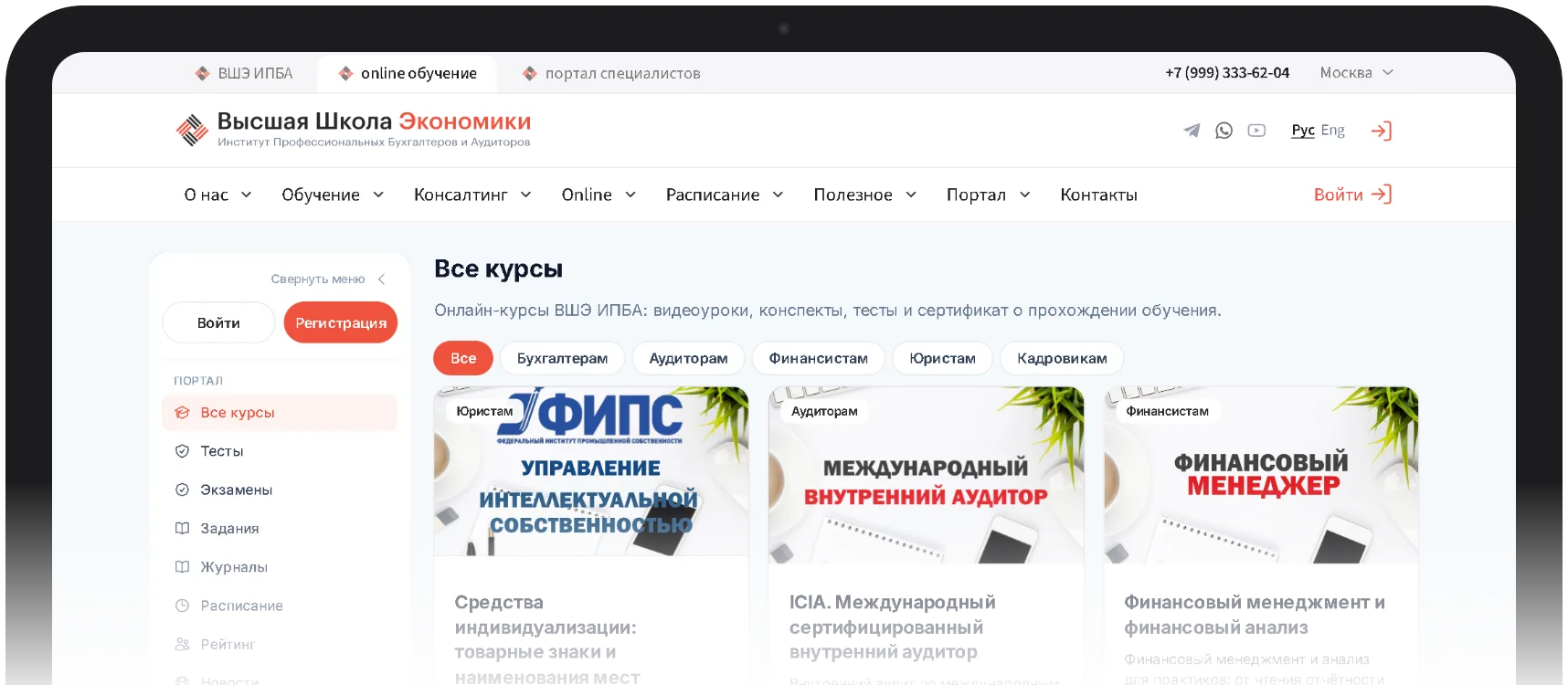
A convenient learning platform
A personal account with a clear interface: manage your learning, track your progress and talk to instructors in one place.
Learning materials
All lectures, presentations and assignments in one place
Class schedule
A calendar with reminders about upcoming classes
Progress
Grades and completed assignments
Video lectures
Watch lectures whenever it suits you
FAQ
Questions about the "Audit" service
Didn’t find the answer? Ask us — a manager will reply and help you choose a programme.
Ask a question01 What does the "Audit" service include?
An audit of accounting (financial) statements that HSE IPAA conducts together with partner audit firms that are members of an SRO of auditors. We agree on the stages, expected results, timelines and the list of required documents, and set all of this out in a commercial proposal. The audit report is issued by the partner audit firm in accordance with Federal Law No. 307-FZ.
02 Who is this service for?
Companies and entrepreneurs who need an independent review of their accounting and financial statements without expanding their own staff.
03 How is the project work organized?
First comes a consultation and diagnostics. Then we draw up a plan, assign responsible specialists to the project, complete the agreed stages and hand over the results to the client.
04 What do the timeline and cost depend on?
On the scope of work, the state of the source data, the complexity of the task and the required depth of the audit. We quote exact terms after an initial assessment.
05 How is confidentiality protected?
Client information and documents are used only to perform the agreed work. Only the specialists involved in the project have access to them.
About the service “Audit”
HSE IPAA offers audit services together with partner audit firms that are members of a self-regulatory organization of auditors. The audit is performed by the partner firm's auditors, and the audit report is issued by the partner audit firm in accordance with Federal Law No. 307-FZ "On Auditing Activities." We organize the work, agree on the plan and timeline, and support the project from the first meeting to the final debriefing. We also provide training and workshops for auditors.
Organizing and Conducting an Audit
A statutory audit is carried out in cases established by law. Many companies undergo an audit only when the law requires it, but a voluntary audit is useful in other situations as well:
- to make sure the company's accounting is maintained correctly;
- to prepare for a tax audit;
- to assess the state of financial management;
- to review how customer relationship management is organized.
Stages of an Audit
In practice, an audit can be broadly divided into several stages.
1. Analysis of the audited entity and team formation.
A detailed analysis of operations at the very start shows in which areas failures and violations are most likely to occur.
2. Negotiations and agreement on audit stages.
A working audit plan is drawn up.
3. Analysis of the business environment and market conditions.
Auditors need to understand the market situation, the business environment, the company's business goals and the owners' influence: all of this determines the client's business risk and, therefore, the related audit risk.
4. Review of the internal audit function.
A meeting with the internal auditors and a review of their reports save time during the main audit and make it possible to focus on what matters most.
5. Preparing a risk map.
Every company needs a risk map. When preparing it, all areas that require constant monitoring can be taken into account.
6. Performing audit procedures.
All planned and agreed audit activities are carried out.
7. Preparing the audit report.
The audit results are summarized. At a minimum, at this stage:
- significant issues identified during the audit are discussed and resolved;
- audit risks identified during planning and the assessment of the internal control system are addressed;
- the adjustments that need to be made to the client's financial statements are described;
- an overall analytical review of the financial statements is performed;
- the partner audit firm prepares and issues the audit report.
8. Wrap-up.
To complete the audit efficiently, a meeting is held with the client's responsible employees and the members of the project team. The meeting covers:
- the draft financial statements;
- the management letter;
- issues identified during the audit and ways to resolve them;
- tax matters;
- any outstanding issues, if they remain.
By the end of the meeting, all participants should share the same understanding of these issues. The client also receives a final list of correcting entries with explanations and calculations and, if necessary, explanations on converting statements prepared under Russian standards into IFRS statements. This meeting is held before the audit report is signed and issued.
Not sure which program to choose?
Our specialists will help you choose a program for your goals and answer all your questions. The consultation is free!
Reach us in one click: call us.
+7 (999) 333-62-04
contact us via messengers


