 HSE IPAA




Trademark Registration
We support trademark registration from the preliminary check through to the examination decision. We help reduce the risk of refusal, choose the right Nice Classification classes and build brand protection for the future.
 Support at every stage
 Intellectual property specialists
 A registered trademark as a company asset

0
Why register a trademark
Trademark registration protects the money invested in your brand. Anyone can register an unregistered brand in their own name, including "patent trolls".

Profit growth along with brand recognition

Licenses, royalties and franchising

A trademark as an intangible asset
What registration gives you
 Exclusive rights to your name and logo
Royalties from licensing the mark
The opportunity to sell a franchise
Recovery of compensation from infringers through the courts
The opportunity to work with large retail chains
Growth in company value through an intangible asset
Protection against "patent trolls" and unscrupulous competitors
Why it is convenient to work with us
We support brand registration and advise on intellectual property matters.

Preliminary check
We assess the designation and search for similar trademarks.

Legal assessment
We take into account the requirements of the Civil Code of the Russian Federation and the specifics of the claimed list of goods and services.

A well-prepared application
We help you choose Nice Classification classes and prepare the materials.

Registration support
We monitor the progress of the procedure and respond to Rospatent's requests.

Risk reduction
We identify possible grounds for refusal and conflicts of rights in advance.

Brand protection
We advise on the use, renewal and protection of your trademark.
What we need from you
To get started, information about your brand and your company's activities is enough.

Designation
Name, logo or other brand designation

Lines of business
Goods and services that need protection

Applicant details
Company or entrepreneur details

Brand materials
Images, packaging, examples of use
Who this service is for
Companies that invest in brand promotion
Manufacturers of goods
Franchise networks
Startups and new products
Professionals with a personal brand
What trademarks can be registered
A trademark can be more than just a name: word, figurative, three-dimensional, color, sound and other designations are all protected.

Brand protection
Others will not be able to use an identical or similar designation.

Intangible asset
The mark can be included in the company's assets, increasing its value.

Brand income
You gain the opportunity to grant licenses, receive royalties and sell a franchise.
- registration of the name of a company, product or service
- registration of the brand's logo and corporate graphics
- registration of a unique packaging shape: boxes, bottles, vials
- registration of a unique color or color combination of a product
- registration of a melody by which customers recognize the brand
- registration of your own name for business activities
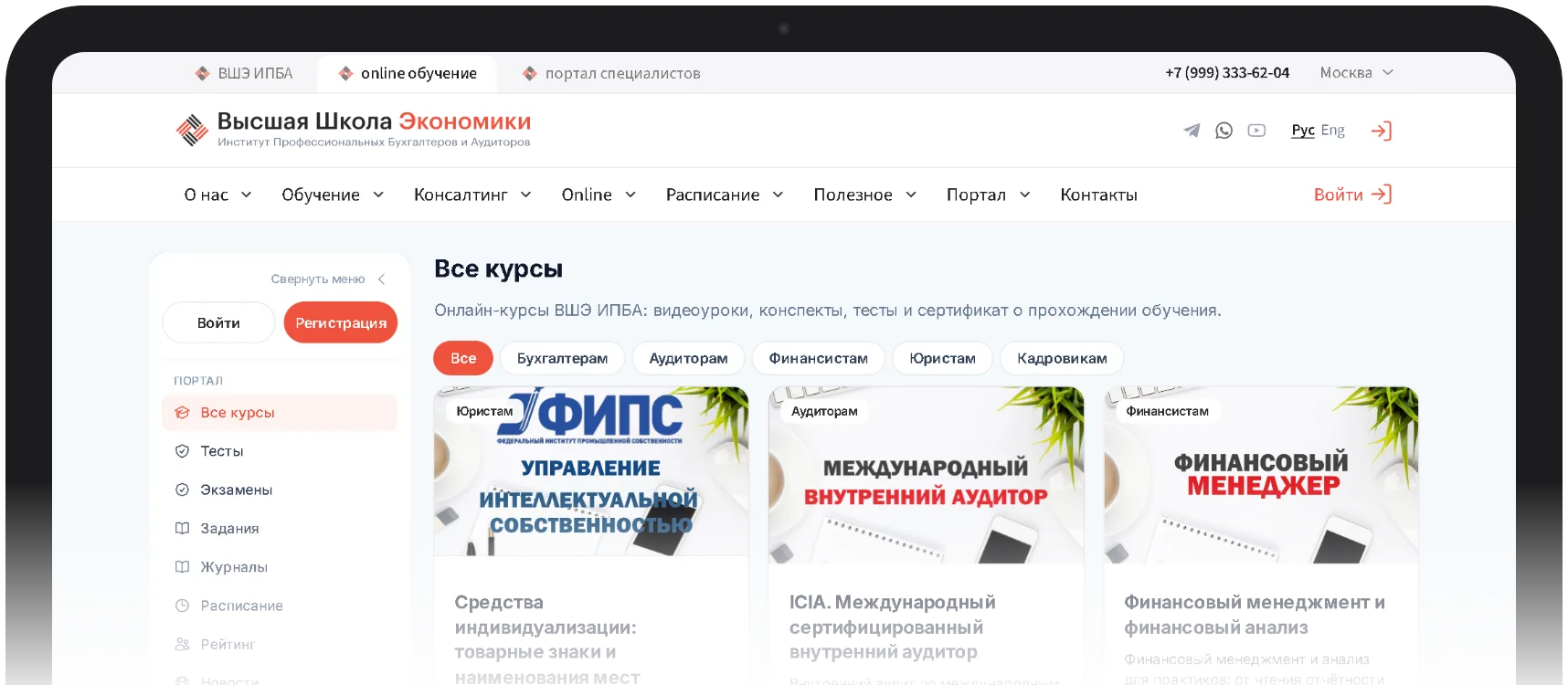
A convenient learning platform
A personal account with a clear interface: manage your learning, track your progress and talk to instructors in one place.
Learning materials
All lectures, presentations and assignments in one place
Class schedule
A calendar with reminders about upcoming classes
Progress
Grades and completed assignments
Video lectures
Watch lectures whenever it suits you
FAQ
Questions about the Trademarks service
Didn’t find the answer? Ask us — a manager will reply and help you choose a programme.
Ask a question01 What does the trademark registration service include?
The scope of work is defined after we review your task. We agree on the stages, expected results, timeline and list of required documents, and set all of this out in a commercial proposal.
02 Who is this service for?
Companies and entrepreneurs who want to protect their brand without keeping an intellectual property specialist on staff for this purpose.
03 How does the work proceed?
First comes a consultation and a check of the designation. Then we select the Nice Classification classes, prepare and file the application, support the examination and keep you informed at every stage.
04 What determines the timing and cost?
The type of designation, the number of Nice Classification classes, the results of the preliminary check and the scope of support. We quote exact terms after an initial assessment.
05 How is confidentiality protected?
Client information and materials are used only to perform the agreed work. Only the specialists involved in the project have access to them.
About the service “Trademarks”
Trademark registration
The main benefit a company gets from registering a trademark is protection of the money invested in its brand. Every entrepreneur spends money on promoting the brand: paying for advertising, search engine and social media promotion, developing packaging and ordering promotional materials. Over time, the brand becomes recognizable.
If a brand is not registered, anyone can register it in their own name — not just a competitor or a company from another region. There are so-called "patent trolls": they look for unregistered brands, register them in their own name, and then demand money from the business owners for the right to keep using their own name.
What else trademark registration gives you
- a recognizable brand helps increase profits;
- the mark can be licensed to others in exchange for royalties;
- it becomes possible to sell a franchise;
- compensation can be recovered from infringers through the courts;
- it is easier to start working with large retail chains;
- a trademark can be recognized as an intangible asset, which increases the value of the company.
The law does not require you to register a trademark. But without registration, a business owner cannot be sure that the brand will remain theirs and that the investment in promoting it will not end up benefiting competitors or "patent trolls".
Intellectual property protection symbols
© — the copyright symbol. It is used to mark works: songs, books, computer programs, articles, drawings, photographs — anything created by an author or a team of authors. Copyright arises at the moment a work is created and does not require registration; the author can be an ordinary individual, not only an organization.
® — the symbol of a registered trademark. A trademark can be a logo, a slogan, a name, a packaging shape or any other designation by which customers recognize your products and distinguish them from those of competitors. Only the owner of a registered mark is entitled to use ®.
™ — a symbol that, in international practice, is often placed next to a brand that has not yet been registered. In Russia, the official trademark protection symbol is ®.
Types of trademarks
Almost any designation by which customers distinguish a company from its competitors can be registered. There are seven types of trademarks.
Word mark — a name. It can be registered either in a proprietary typeface or without one. Another company will not be able to register the same name simply by changing the color or style of the letters.
Figurative mark — an emblem or image by which the company is recognized. No one else is entitled to place a registered image on their products.
Combined mark — usually a logo in which an image is combined with lettering. It suits those who always use the name together with the emblem: one registration instead of two separate ones.
Three-dimensional mark — most often a packaging shape. Companies with a unique design of boxes, bottles or vials register it so that competitors cannot release products in the same packaging.
Color mark — a unique color or combination of colors developed for a product.
Tactile mark — for example, a name and slogan printed in Braille; such marks are registered by manufacturers of goods for blind people.
Sound mark — a melody by which customers recognize the brand.
Once a mark is registered, other companies are not entitled to use an identical or confusingly similar designation for the same goods and services.
A name as a trademark
Anyone who builds a personal brand can register their own name as a trademark. People with the same surname or first name will, of course, continue to bear their names, but they will not be able to conduct business under that name in the same field for which the mark is registered without the owner's consent — they will have to choose a different designation.
For example, a psychologist registers the name "Galina Ivanova" as a trademark for psychological services. Other Galina Ivanovas may work as employed psychologists, but they are not entitled to run a private practice or a blog as psychologists under that name without permission: the trademark owner may demand that the infringement stop and that compensation be paid — up to RUB 5 million.
How trademark registration works
It usually takes about a year from filing the application to registration.
Checking the designation
Before filing an application, the designation is checked against databases of registered marks and filed applications. If the name is an invented word that does not exist in the language, a check against registered marks is sometimes enough. If ordinary words are used, it is better to conduct a full search with the involvement of a patent attorney.
Selecting Nice Classification classes
A business usually needs registration in several classes of the International Classification of Goods and Services (Nice Classification) at once. For example, a store needs all the classes of goods it sells; many product groups, including food and sewing supplies, are also spread across several classes. If you are planning a new line of business, it is better to include the relevant class in the application in advance.
From the filing date of the application, you acquire a right of priority: if another company later files an application for the same designation, it will be refused.
Examination
Rospatent examiners check whether there are identical or similar designations among previously filed applications and registered marks. If any are found and registration is refused, the examination fee paid is not refunded.
Payment of the registration fee
After a positive examination decision, the trademark registration fee is paid; its amount depends on the number of Nice Classification classes.
Registration and receipt of the certificate
The mark is entered in the State Register of Trademarks, and the owner receives a certificate.
If no similar designations are found, it is quite possible to register a mark on your own. The main thing is to correctly identify all the necessary Nice Classification classes, fill out the documents properly and pay the fees.
Keep in mind: if you file an application in three classes at once, you pay once. But if you first file an application in two classes and a month later decide to add a third, you will have to file a new application and pay again — the list of goods and services in an application that has already been filed cannot be expanded.
HSE IPAA's partner in the field of intellectual property is FIPS — the Federal State Budgetary Institution "Federal Institute of Industrial Property".
Contact us — our specialists will help you register your trademark.
Not sure which program to choose?
Our specialists will help you choose a program for your goals and answer all your questions. The consultation is free!
Reach us in one click: call us.
+7 (999) 333-62-04
contact us via messengers


