 HSE IPAA



Contract Law
Contract work, international contracts and resolution of civil disputes
 2-day seminar
 Case studies and handouts
 HSE IPAA certificate of completion
44 500 ₽
/course
35 000 ₽
/course

0
Seminar objective
To give lawyers and practitioners a method for organizing contract work at a time when legislation and case law keep changing.

Contract drafting

Wording contract terms

Protecting rights under a contract
What you will learn
 A method for organizing contract work
Preparing standard contract forms
Finding and fixing typical errors in contracts
Working with preliminary agreements and conditional transactions
Using currency clauses in contracts
Choosing ways to secure obligations
Choosing between a state court and international arbitration
A method for organizing contract work
Preparing standard contract forms
Finding and fixing typical errors in contracts
Working with preliminary agreements and conditional transactions
Using currency clauses in contracts
Choosing ways to secure obligations
Choosing between a state court and international arbitration
Why this program matters
Working with foreign counterparties requires understanding how foreign law and international contract instruments apply and how they differ from Russian ones.

Comparative analysis
Institutions of international contract practice and their Russian counterparts.

Case law
The program reflects current court approaches to applying the Russian Civil Code.

Practical cases
Case studies from the handouts and a summary at the end of each day.
Entering into a contract in practice
A separate block covers the risks that arise when a contract is drawn up and signed.

Contract details
Preamble, contract date, bank details and seal.

Signing
Facsimile signatures, verifying the signatory’s authority, powers of attorney.

Challenges to conclusion
How to counter a debtor’s refusal to recognize that the contract was concluded.

Exchange of documents
Requirements for offer and acceptance; invoices, specifications, orders and letters of guarantee.
Who this training is for
Corporate lawyers
In-house counsel
Contract managers
Heads of legal departments
Foreign trade specialists
Procurement specialists
Company executives
Seminar program
Two days: contract law and contract practice first, then international contracts and dispute resolution.

2
seminar days

4
topic blocks

1
contract template to analyze
- Freedom of contract and its limits, unnamed contracts, mandatory rules, preliminary agreements, conditional transactions.
- Contract details, date, facsimile signatures, verification of authority, concluding a contract by exchanging documents, framework agreements.
- Acceptance, performance by a third party, time, place and moment of performance, currency clauses.
- Pledge, suretyship, independent guarantee, earnest money, set-off, novation, impossibility of performance, unilateral withdrawal.
- Governing law, contracts with non-residents, letters of credit and guarantees, trade finance, Incoterms, FIDIC contracts.
- State court or international commercial arbitration, arbitration proceedings, mediation.
Course price
35 000 ₽

Learn now, pay later!
4 265
₽/mo
3 354
₽/mo
Installments for 12 months
15%
Enroll in the course or get a free consultation
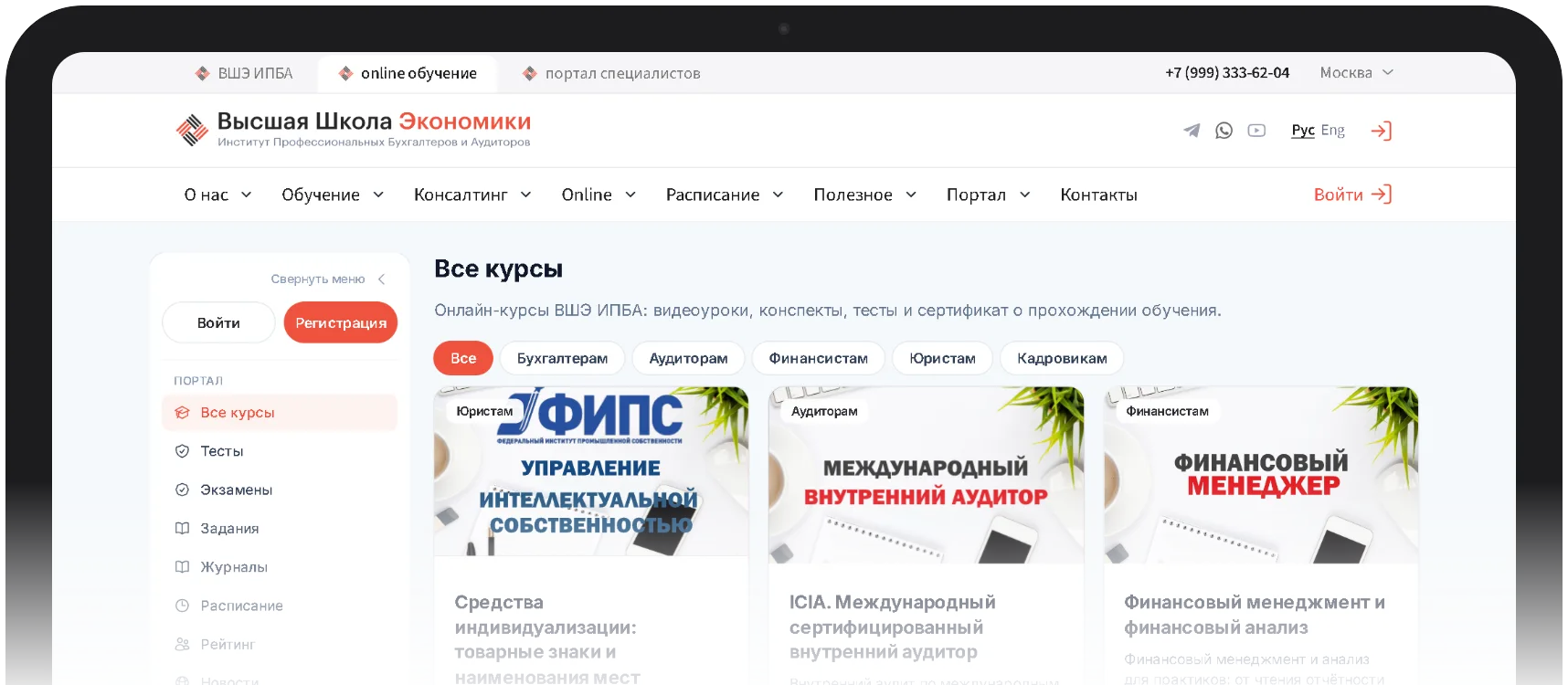
Удобная платформа для обучения
Личный кабинет с понятным интерфейсом: управляйте обучением, следите за прогрессом и общайтесь с преподавателями в одном месте.
Учебные материалы
Все лекции, презентации и задания в одном месте
Расписание занятий
Календарь с напоминаниями о ближайших занятиях
Прогресс
Успеваемость и выполненные задания
Видеолекции
Смотрите лекции в удобное время
Frequently Asked Questions
When are classes held?
Groups start as soon as enough participants enroll, and class times are agreed with the participants. Online courses can be taken at any convenient time in the Online Learning section.
How much does training cost?
The price of each course is listed in the schedule. Terms for corporate groups are discussed separately.
Who teaches the classes?
Instructors with extensive practical and academic experience; many of them hold professional certifications, academic degrees and titles.
Where does training take place?
In our classroom in Moscow, at the client’s premises, or online in the Online Learning section.
Can I study from another city?
Yes. Online courses are available from any region of Russia: lectures, materials and tests are gathered in your personal account in the Online Learning section.
How long does a course last?
It depends on the program: the duration is shown on each course page in the catalog. For online courses, the duration is shown to the minute.
Course price
35 000 ₽
Learn now, pay later!
4 265
₽/mo
3 354
₽/mo
Installments for 12 months
15%
Enroll in the course or get a free consultation
Contract Law, International Contracts and Resolution of Civil Disputes
Who the seminar is for
Corporate lawyers and managers responsible for a company’s contract work.
Seminar objective
A contract specialist must be confident with the Russian Civil Code and keep track of developments in case law. The seminar gives lawyers and practitioners a method for organizing contract work at a time when legislation and its application keep changing.
Sessions cover ways to manage legal risks in contractual relationships and techniques for drafting contracts and wording their terms. Participants get answers to current questions of contract law and practical recommendations on how to set up contract work, prepare standard contract forms and protect their rights under a contract.
A separate day is devoted to contracts with foreign counterparties: choice of governing law, instruments for securing and financing foreign trade transactions, delivery terms and international model contracts. Institutions of international contract practice are compared with their Russian counterparts, and participants discuss how to use these instruments in everyday work.
Seminar program
Day 1
General issues of contract law. Entering into a contract in practice
- Freedom of contract and its limits. Unnamed (innominate) contracts: theory and practice, risks of non-standard structures, case examples. Mandatory and default rules: where the line lies and whether the parties can agree otherwise.
- Contract duration: applying terms to prior relations, the fate of terms after termination.
- Preliminary agreement: execution, resulting legal relations, consequences of refusing to sign the main contract, compelling conclusion and recognizing a contract as concluded.
- Conditional transactions: how to set out a condition precedent or subsequent, whether conditions depending on the will of one party are permissible, whether an offer and acceptance can be made subject to a condition.
- Contract execution: typical mistakes, contract details (preamble, date, bank details, seal).
- Signing a contract: facsimile signatures, initial verification of a signature’s authenticity, cases of forgery and abuse.
- Protecting a contract against falsification and bad-faith counterparties: necessary clauses, text layout, initialing, binding.
- Essential terms of a contract and how to identify them.
- Verifying the authority of the signatory: which documents to request, the risk of a change of CEO, independent status checks.
- Verifying a representative’s authority: authority implied “from the circumstances,” powers of attorney, delegation, the risk of a power of attorney being revoked, an order as the basis of authority.
- Consequences of a representative acting without or beyond authority. How to prove subsequent approval of a transaction.
- Contracts signed by an acting head: legal nature, verification of authority, case law.
- Contracts signed by heads of branches and representative offices: their legal status and typical execution errors.
- Bad-faith challenges to the conclusion of a contract by a debtor who does not want to perform or has lost interest in the deal. How to counter claims of exceeded authority, a missing or revoked power of attorney, a disputed signature or unagreed essential terms.
- Concluding a contract by exchanging documents: requirements for offer and acceptance, the acceptance period, acceptance with reservations. Invoices, specifications, orders, letters of guarantee. Contracts concluded by email and other means of communication: advantages and risks.
- Protocol of disagreements: when the contract is concluded, performance before the terms are finally agreed.
- Long-term contractual relationships. A framework agreement and its legal nature. The obligation to order goods, works or services under a framework agreement. Allocating terms between the framework agreement and supplementary agreements, agreeing a supplementary agreement by exchanging documents or by conduct. Performance “on request.” Subscription contracts.
Analysis of a work contract (template from the handouts)
Performance of contractual obligations
- Typical mistakes in documenting acceptance: delivery notes, transfer and acceptance certificates, work acceptance certificates. Verifying the authority of the person accepting goods, works or services.
- Performance to an unauthorized person and its consequences. What to do if the debtor denies receiving goods, works or services.
- Performance of an obligation by a third party: risks and documentation (Art. 313 of the Russian Civil Code).
- Time of performance: whether a delivery or completion date can be tied to an advance payment, how to establish delay if the contract sets no deadline, whether a claim letter is required.
- Place and moment of performance: when a monetary obligation is deemed performed in cashless settlements, how to determine the place of delivery under different contracts.
- Currency clauses under an unstable exchange rate: ways to fix the rate, multi-currency clauses, the creditor’s choice of rate, interest on foreign currency debts, the currency of the claim.
- Case study from the handouts
- Summary, questions and answers
Security for obligations
- Pledge: the collateral and its valuation, pledge of future things and rights, securing future obligations and obligations described in general terms, the right of following, loss or impairment of the collateral, its use and disposal, protecting the pledgee’s rights, the bona fide purchaser, out-of-court enforcement, pledge of goods in circulation.
- Suretyship: execution, essential terms, termination, consequences of amending the main contract, the debtor’s death or liquidation.
- Independent guarantee: its abstract nature, how it differs from suretyship, grounds for challenge.
- Earnest money: relation to a penalty, earnest money in a preliminary agreement.
- Retention: how it differs from suspending counter-performance, grounds for use.
- Unnamed security instruments: security deposit, escrow, repo transactions, risk and liability insurance.
- Case study from the handouts
Termination of contractual obligations
- Whether an obligation can be terminated in the event of improper performance.
- Set-off of counterclaims: procedure and challenge, set-off by agreement of the parties, homogeneity of claims, set-off of penalties and other sanctions.
- Novation: novation of time-barred obligations, novation of penalties and damages, how novation differs from amending contract terms, termination of security upon novation.
- Termination of an obligation due to impossibility of performance. Force majeure and temporary impossibility, a “waiting period” in the contract, allocation of risks between the parties. The fate of a contract when a counterparty’s license is revoked.
- Unilateral withdrawal from a contract under law and under the contract.
- Choosing how to resolve foreign trade disputes: state court or international commercial arbitration. Advantages, disadvantages and specifics of arbitration.
Day 2
- Fundamentals of contract law
- Core principles of Russian contract law
- Governing law
- Language of the contract
- Form and content of the contract
- Essential terms of the contract
- Procedure and date of concluding a contract with a non-resident
- Amendment and termination of a contract
- Grounds for termination of obligations
- Organization and techniques of contract work with non-residents
- Security for performance
- Letter of credit
- Types of letters of credit
- Rules for working with letters of credit
- Guarantees
- UNCITRAL fundamentals and principles
- Tender guarantees
- Performance guarantees
- Performance bond
- Stand-by letter of credit
- Bank guarantees
- Export credit agency (ECA) guarantees
- Suretyship
- Pledge
- Retention
- Insurance
- Indemnity in English contract law
- Letter of credit
- International trade finance
- Bank loans
- Export finance
- Finance leasing
- Factoring
- Incoterms delivery terms
- EXW
- FCA
- CPT and CIP
- DAP, DPU and DDP
- FAS and FOB
- CFR and CIF
- FIDIC contracts with non-residents
- Red Book
- White Book
- Orange Book
- Yellow Book
- Short Form
- Turnkey contract (EPC)
- Contracts for plant supply, design and construction
- Alternative methods of resolving civil and commercial disputes
- Arbitration proceedings and international commercial arbitration: concept, participants, jurisdiction of the tribunal, Russian legislation.
- Mediation: regulation in Russia (193-FZ), areas of application, principles and stages of the procedure.
Day summary, questions and answers.
Seminar wrap-up.
Not sure which program to choose?
Our specialists will help you choose a program for your goals and answer all your questions. The consultation is free!
Reach us in one click: call us.
+7 (999) 333-62-04
contact us via messengers


