 HSE IPAA



Continuing Professional Development for Lawyers
A two-day intensive on business law: litigation and debt collection, contracts, corporate and employment law in light of recent changes to Russian legislation
 2 days
 7 thematic blocks
 HSE IPAA certificate
44 500 ₽
/course
35 000 ₽
/course

0
About the course
The program concisely covers the main legal issues facing businesses: disputes, contracts, corporate governance, inspections and employment relations. Over two days, participants systematically update their knowledge and get answers to questions from their practice.

Contract and obligations law under the Russian Civil Code

Corporate law: JSCs and LLCs

State control and employment law
What you will gain
 Updated knowledge of legislation and case law
Answers to pressing questions from your own practice
Handouts included in the fee
Bonus: 3 months of free consultations by email or phone
Practical recommendations on managing litigation
Review of current case law on contracts
HSE IPAA certificate of completion
Updated knowledge of legislation and case law
Answers to pressing questions from your own practice
Handouts included in the fee
Bonus: 3 months of free consultations by email or phone
Practical recommendations on managing litigation
Review of current case law on contracts
HSE IPAA certificate of completion
Program advantages
An intensive, practical format: the key topics in two days

Concentrated delivery
The main legal issues of business activity presented concisely and systematically

Support after the course
3 months of free consultations by email or phone

Up-to-date rules
Every block reflects the latest changes to Russian legislation
What you will need
The course is designed for practicing lawyers and executives

Basic legal knowledge
An understanding of the fundamentals of Russian civil law

2 days of attendance
The program runs over two full training days

Practical interest
Questions from your own practice are welcome

Readiness for an intensive
A large amount of material in a short time
Who this course is for
In-house lawyers
Company executives
Business owners
Corporate lawyers at JSCs and LLCs
Contract specialists
Litigation specialists
Anyone who needs law in their work
Program content
Day 1 — litigation, debt collection and contracts; Day 2 — corporate law, state control and employment law

2
days of training

3 mo
of free consultations

7
thematic blocks
- Jurisdiction, filing a claim, notification of parties, interim measures, legal costs, representation, challenges, settlement agreements; writ, simplified and claim proceedings; appeal, cassation, review on the basis of new and newly discovered circumstances
- Pre-trial settlement of debt collection disputes, notarial writ of execution, mediation under Federal Law No. 193-FZ: principles, stages, requirements for the mediator, mediation agreement; arbitration, judicial conciliation, settlement agreement
- Federal Law “On Enforcement Proceedings”: foreclosure on debtor property, challenging actions of a bailiff, completion and termination of proceedings; litigation tactics and strategy, evidence and the burden of proof
- Freedom of contract, general rules on transactions, invalidity of transactions, verifying authority, concluding and terminating contracts, security for and termination of obligations, change of parties, performance, liability; sale, lease, work contracts, services, loans, intermediary contracts
- Governance system and competence of bodies, charter capital and net assets, challenging decisions, derivative claims, directors’ liability; JSCs and LLCs: charter, corporate documents, participants’ rights, dividends, withdrawal and expulsion of a participant, antitrust control
- Procedure and time limits for control activities, documenting and challenging results, administrative liability under the Russian Code of Administrative Offenses; employment contract, working and rest time, remuneration, discipline, material liability, compensation for harm to employees, labor disputes
Course price
35 000 ₽

Learn now, pay later!
4 265
₽/mo
3 354
₽/mo
Installments for 12 months
15%
Enroll in the course or get a free consultation
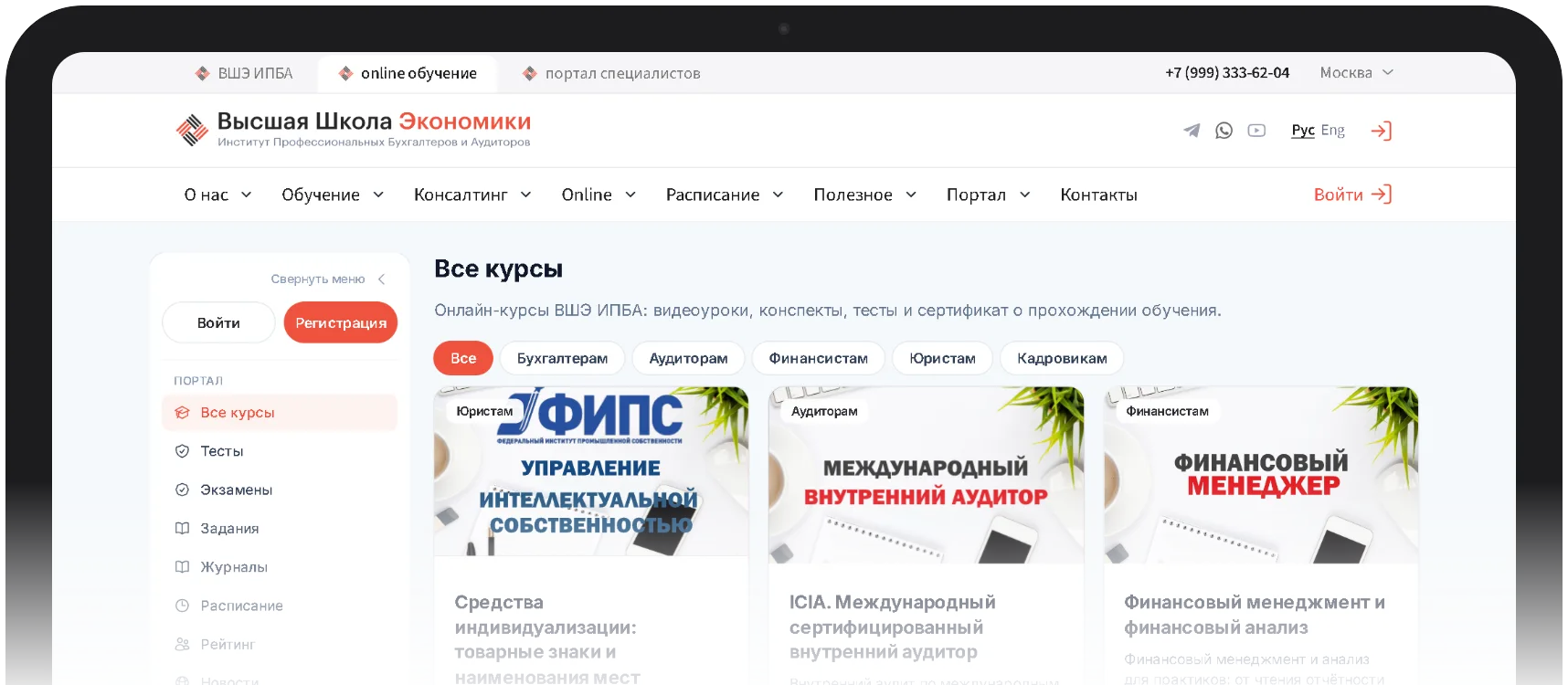
Удобная платформа для обучения
Личный кабинет с понятным интерфейсом: управляйте обучением, следите за прогрессом и общайтесь с преподавателями в одном месте.
Учебные материалы
Все лекции, презентации и задания в одном месте
Расписание занятий
Календарь с напоминаниями о ближайших занятиях
Прогресс
Успеваемость и выполненные задания
Видеолекции
Смотрите лекции в удобное время
FAQ: Continuing Professional Development for Lawyers
Who is this course for?
In-house lawyers, executives and business owners, contract and litigation specialists — anyone who needs to quickly update their knowledge of key legal issues in business.
What does the program cover?
Civil and commercial (arbitrazh) procedure, debt collection and enforcement proceedings, contract and obligations law, corporate law for JSCs and LLCs, state control and administrative liability, employment law and labor disputes.
Are there practical sessions?
Yes. The material is covered through practical scenarios and cases from case law, and participants are welcome to bring questions from their own work.
How long is the training?
The seminar runs for 2 full days and includes 7 thematic blocks.
What document do I receive after the training?
Upon completion, you receive an HSE IPAA certificate of completion. In addition, for 3 months after the seminar you can consult us free of charge by email or phone.
Course price
35 000 ₽
Learn now, pay later!
4 265
₽/mo
3 354
₽/mo
Installments for 12 months
15%
Enroll in the course or get a free consultation
Who it is for
In-house lawyers, executives, business owners and anyone whose work requires a confident grasp of the legal framework governing business activity.
Seminar objective
To present, concisely and systematically, the key legal issues businesses face: from litigation and contract work to corporate governance, inspections by regulatory authorities and employment relations. Over two days, participants update their knowledge in light of the latest legislative changes and get answers to questions from their own practice.
- Handouts are included in the fee.
- Upon completion, participants receive an HSE IPAA certificate of completion.
- Bonus: 3 months of free consultations by email or phone.
Program content
Day 1
1. Procedural law
1.1. Civil and commercial (arbitrazh) procedure, including recent changes
Jurisdiction, filing a claim, notification of parties, interim measures, legal costs, formalizing representation, challenges, settlement agreements. Hearing a case at first instance, review of court rulings on appeal and in cassation, and on the basis of new and newly discovered circumstances.
Pre-trial settlement of debt collection disputes
- Claim procedure and notarial writ of execution.
- Mediation under Federal Law No. 193-FZ: scope, principles and stages of the procedure, requirements for the mediator and their role, choosing a mediator, criteria for whether a dispute is suitable for mediation, conduct of the procedure, mediation agreement.
Debt collection through the courts
- Writ proceedings: categories of cases, state duty, time limits, issuance and cancellation of a court order, refusal to issue it, legal force of the order.
- Simplified proceedings: categories of cases, time limits, hearing procedure, appealing the decision, transition to ordinary claim proceedings.
- Claim proceedings: subject and scope of claims, risks of a counterclaim, assessing whether litigation is worthwhile.
- Statement of defense: content, format, filing procedure.
- Counterclaim and the conditions for its acceptance by the court.
- Interim measures: preparing a motion, appealing a refusal to grant them.
- Consequences of changing the grounds or subject of a claim, withdrawing a claim, admitting a claim and concluding a settlement agreement.
- Parties to the case and their procedural rights; third parties with and without independent claims.
Alternative methods of resolving commercial disputes
Arbitration: concept, arbitration rules, arbitration agreement. Conciliation procedures in court, judicial conciliation, settlement agreement.
1.2. Enforcement proceedings
Current issues in applying the Federal Law “On Enforcement Proceedings”: foreclosure on specific types of debtor property, challenging actions and decisions of a bailiff, grounds for completion and termination of enforcement proceedings.
1.3. Managing litigation
Practical recommendations for preparing and conducting cases in commercial (arbitrazh) courts, courts of general jurisdiction, arbitral tribunals and international commercial arbitration: pre-trial work and gathering information on a potential defendant, tactics and strategy for claimant and defendant, a litigation checklist, collecting evidence and allocating the burden of proof.
2. Private law
2.1. Contract and obligations law, including amendments to the Russian Civil Code
- Freedom of contract: mandatory and default rules, unnamed and mixed contracts.
- General rules on transactions: time limits, conditional transactions, legally significant communications.
- Invalidity of transactions: contravention of law, transactions detrimental to the company, fraud, lack of required consent, a director or representative exceeding their authority, limits on challenging transactions.
- Documenting and verifying authority to enter into a contract.
- Concluding a contract: pre-contractual liability, representations as to circumstances, execution and signing procedure, moment of conclusion, exchange of documents and electronic form, essential terms and the consequences of failing to agree on them, framework, preliminary, option and subscription contracts.
- Security for obligations: suretyship, independent guarantee, pledge, retention, deposit, escrow, security payment.
- Termination of obligations: novation, accord and satisfaction, set-off, debt forgiveness, impossibility of performance — based on case law.
- Change of parties to an obligation: contractual prohibition on assignment and the consequences of its breach, assignment of future claims, transfer of debt.
- Performance of obligations: good faith, documenting performance and the risks of errors in primary documents, performance to a third party, time and place of performance, currency clauses.
- Termination of a contract: unilateral repudiation and judicial termination, material breach, material change of circumstances, refund of prepayment.
- Liability for breach of contract: proving damages, penalties and their reduction, interest for the use of another party’s funds and commercial credit, specific performance, suspension of counter-performance.
- Real estate transactions: state registration of rights, reliability of the register, challenging actions of the registration authority.
- Sale and supply, including sale of real estate, shares in joint-stock companies and LLC interests, and future goods; investment contracts.
- Real estate leases: documentation, lease of part of a building and of a future asset, registration of long-term leases, terms and renewal, rent changes, termination.
- Construction contracts: essential terms and deadlines, handover and acceptance, consequences of breaches, unilateral repudiation.
- Paid services: difference from a work contract, essential terms, the result as the subject of the contract, unilateral repudiation and termination fees.
- Loans and credit: moment of conclusion, credit lines, bank fees, interest and penalties, withdrawal from the contract and early repayment demands.
- Intermediary contracts: agency, commission and agent agreements in case law.
Day 2
2.2. Corporate law, including recent changes
The company’s governance system and the competence of its bodies, formation and increase of charter capital, challenging decisions of governing bodies, derivative claims and other corporate disputes, directors’ liability.
- Joint-stock companies: charter, mandatory corporate documents, shareholders’ rights and obligations, dividends, reorganization and liquidation.
- LLCs: charter, corporate documents, participants’ rights and obligations, withdrawal from the company and acquisition of interests by the company itself, expulsion of a participant, profit distribution, reorganization and liquidation.
- Charter capital: shares, increase and reduction of a joint-stock company’s capital, splits and consolidations, issue and payment for shares, pre-emptive rights, buyback and acquisition of shares; payment for and changes to an LLC’s charter capital, consequences of non-payment, contributions to company assets; net assets.
- Corporate governance: general shareholders’ meeting (convening, holding, voting), board of directors, sole and collegial executive bodies, management company, election and early termination of powers, major and interested-party transactions, LLC governing bodies and the procedure for holding a general meeting of participants.
- Antitrust control: affiliated persons and groups of persons, merger control, foreign investment control, transactions in shares and interests.
2.3. State control (supervision) and administrative liability
The system of control (supervisory) authorities, types and procedure of control activities, time limits and frequency, notification of the organization. What officials may not do during an inspection. Documents issued following an inspection and possible consequences. Gross violations of inspection procedure and invalidation of its results: grounds, case law, practical advice. Challenging actions (or inaction) of officials through administrative and judicial channels, appeals to the prosecutor’s office. Administrative liability under the Russian Code of Administrative Offenses: a step-by-step approach for the organization.
3. Employment law, including recent changes
- Parties to employment relations: employee, employer, trade unions, employee representatives, government authorities.
- Employment contract: concept and content, job function, procedure and time limits for conclusion, fixed-term contracts.
- Transfers, termination of an employment contract at the initiative of the employee and the employer, termination due to circumstances beyond the parties’ control. Case studies.
- Special rules for certain categories of workers: seasonal workers, home-based workers, employees of individual employers, rotational (shift-camp) work, part-time secondary employment, minors, persons with disabilities, employees in hazardous and dangerous working conditions, heads of organizations and members of collegial bodies, employees of small businesses.
- Working time: types, recording and schedules, reduced and part-time working hours, flexible schedules, aggregated working time recording, overtime, night work.
- Rest time: weekends and non-working public holidays, work on those days, types of leave, calculating the length of annual paid leave and service, recall from leave.
- Remuneration: concept and principles, labor standards, time-based and piece-rate systems, the Unified Tariff and Qualification Directory (ETKS), bonuses, pay for overtime and night work, work on weekends and holidays, compensation payments.
- Labor discipline: internal labor regulations, incentives, disciplinary sanctions, time limits and procedure for imposing and appealing them.
- Material liability of the parties: conditions, procedure and amount of compensation for damage, full material liability and its limits.
Compensation for harm to employees
- Employer’s material liability under the Russian Labor Code: for unlawfully depriving an employee of the opportunity to work and for harm to an employee’s life and health.
- Compensation for harm to a person’s life or health under Chapter 59 of the Russian Civil Code: scope and nature of compensation, determining lost earnings, compensation for harm to a minor and in the event of a breadwinner’s death, changes in amount and indexation of payments, compensation upon termination of a legal entity, funeral expenses.
- Compulsory social insurance against industrial accidents and occupational diseases (Federal Law No. 125-FZ).
Labor disputes
- Concept and types of labor disputes.
- Labor disputes commission: formation, competence, time limits for filing, enforcement of decisions.
- Resolution of individual labor disputes in court.
- Collective labor disputes: conciliation procedures, labor arbitration, the right to strike.
Not sure which program to choose?
Our specialists will help you choose a program for your goals and answer all your questions. The consultation is free!
Reach us in one click: call us.
+7 (999) 333-62-04
contact us via messengers


