 HSE IPAA



Tax Advisor
Expert-level tax advisor training: confident work with Russian legislation, tax risk assessment, lawful solutions for businesses, and client support during audits and disputes.
 Days and times by arrangement
 4 blocks, 13 topics
 HSE IPAA certificate of completion
83 000 ₽
/course
65 000 ₽
/course

0
What a tax advisor does
Russian tax legislation is complex and changes often. A tax advisor helps clients pay taxes correctly, reduce their tax burden lawfully, avoid errors and penalties, and represents them in court when necessary.

Working with the business, not reporting forms

Tax planning and lawful optimization

Involvement in tax audits and disputes
What you get after the training
 HSE IPAA certificate of completion
Certificate verifiable on our website
A systematic understanding of the Russian Tax Code
Knowledge of the 2026 tax legislation changes
Skills in managing the tax base and VAT risks
An understanding of desk audits and data matching
A lawful tax optimization strategy
HSE IPAA certificate of completion
Certificate verifiable on our website
A systematic understanding of the Russian Tax Code
Knowledge of the 2026 tax legislation changes
Skills in managing the tax base and VAT risks
An understanding of desk audits and data matching
A lawful tax optimization strategy
Why the profession is in demand
Changes in tax legislation and tighter controls make calculating taxes on your own increasingly difficult, even for large companies.

Three career paths
A consulting or law firm, an in-house role, or private practice.

Up-to-date program
The training is built on the current Russian Tax Code and case law.

Flexible format
Individual, corporate and distance learning in groups of 4–15 people.
Course logistics
The format and schedule are tailored to the participant or company.

Formats
Individual, corporate and distance.

Duration
According to the schedule or by agreement.

Group size
From 4 to 15 people.

Certificate
HSE IPAA certificate of completion.
Who the training is for
Lawyers specializing in tax law
Economists
Accountants and chief accountants
CFOs
Consulting firm staff
Entrepreneurs
Those planning a private practice
Tax Advisor curriculum
Four blocks: the profession and the Russian tax system, 2026 legislative changes, administration and control, expertise and income.

65,000 ₽
course fee

13
program topics

4–15
people per group
- Role, status and responsibility, professional growth strategy, the logic of the Russian tax system.
- Overview of Tax Code changes, tax regimes, VAT, profit tax, personal income tax, social insurance contributions, regional and local taxes.
- Desk audits and data matching, application of the MLI, taxation of transactions with foreign persons.
- Recent case law from 2024–2026 on VAT, profit tax and transactions with foreign persons.
- Building the advisor's personal brand and artificial intelligence as a working tool.
Course price
65 000 ₽

Learn now, pay later!
7 954
₽/mo
6 229
₽/mo
Installments for 12 months
15%
Enroll in the course or get a free consultation
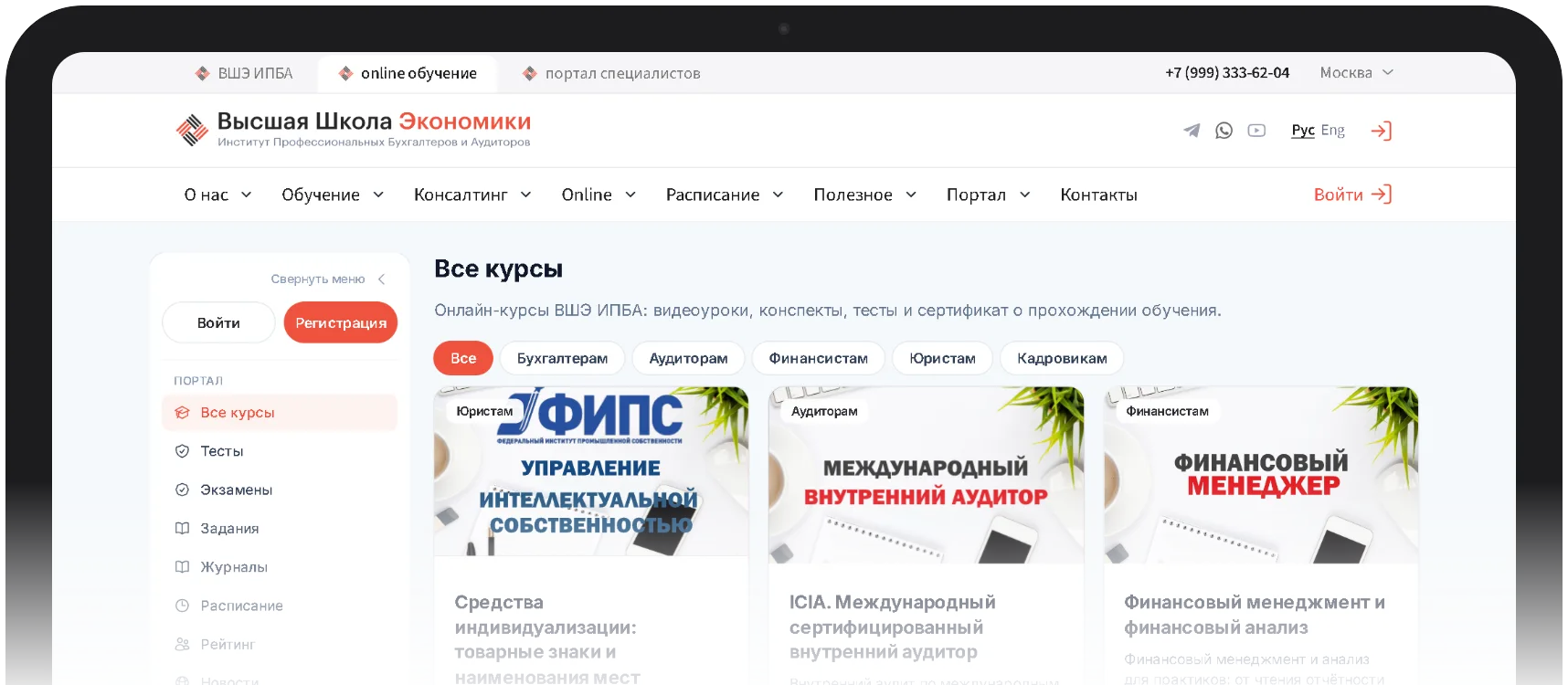
Удобная платформа для обучения
Личный кабинет с понятным интерфейсом: управляйте обучением, следите за прогрессом и общайтесь с преподавателями в одном месте.
Учебные материалы
Все лекции, презентации и задания в одном месте
Расписание занятий
Календарь с напоминаниями о ближайших занятиях
Прогресс
Успеваемость и выполненные задания
Видеолекции
Смотрите лекции в удобное время
Frequently asked questions about the Tax Advisor course
Who is the Tax Advisor course for?
Lawyers, economists, accountants and finance professionals who want to advise businesses on taxes, systematize their knowledge of the Russian Tax Code and reach an expert level, whether in consulting, in-house or in private practice.
What does the course cover?
Four blocks and 13 topics: the profession and the Russian tax system, 2026 legislative changes (tax regimes, VAT, profit tax, personal income tax, social insurance contributions), tax administration and international taxation, case law, and building personal expertise.
Are there practical sessions?
Yes. Theory is covered through practical examples, typical taxpayer mistakes and case law materials, so participants can apply their knowledge with clients right away.
What is the duration and format of the training?
The program consists of 4 blocks and 13 topics. Training is individual, corporate or distance; class days and times are agreed with participants.
What certificate is issued after the training?
An HSE IPAA certificate of completion for the Tax Advisor program. The certificate can be verified on our website by its registration number. The terms of the final assessment are communicated before classes begin.
Course price
65 000 ₽
Learn now, pay later!
7 954
₽/mo
6 229
₽/mo
Installments for 12 months
15%
Enroll in the course or get a free consultation
Tax Advisor: the profession and the training
Russian tax legislation is extensive and changes regularly. Working out how taxes, deductions and tax relief are calculated is difficult not only for individuals but also for large companies. That is why professionals who can apply the Russian Tax Code correctly and support businesses are in demand.
A tax advisor helps clients calculate and pay taxes correctly, reduce their tax burden lawfully, avoid errors that lead to additional assessments and penalties and, when necessary, defend their interests before the tax authorities and in court. Most people who enter the profession are lawyers specializing in tax law, economists and experienced accountants.
A tax advisor acts as a qualified intermediary between the taxpayer and the tax authority. A constructive dialogue based on knowledge of the law and an understanding of the other side's position delivers results faster than conflict. A basic university degree is not enough for this profession: it requires additional training and continuous updating of knowledge.
What a tax advisor does
- advises companies and individuals on taxation;
- explains how tax and levy legislation is applied in practice;
- helps build lawful tax optimization;
- prevents errors in tax calculation and payment deadlines;
- helps set up and maintain tax accounting;
- conducts legal reviews of taxpayer documents;
- represents clients before the tax authorities and in court.
Tax advisory work sits at the intersection of law and economics, so lawyers and economists with relevant degrees have an advantage. Depending on the workplace, an advisor may also prepare guidance materials and recommendations for clients, take part in tax audits and tax planning projects, and write expert articles.
Where tax advisors work
- Consulting or law firm. Team work on projects for various clients, whom the firm brings in.
- In-house. The advisor knows the specifics of one business in depth and is responsible for its tax strategy.
- Private practice. A flexible schedule and fees instead of a salary. It is usually preceded by work at a firm, where the advisor builds a client base.
Program objective
To develop expert-level tax advisor competencies: managing the tax base and VAT risks, providing legal protection for businesses of various legal forms, and building a lawful tax optimization strategy amid tighter tax administration.
Curriculum
Block 1. The tax advisor profession
Topic 1. The role, status and responsibility of a tax advisor
- how a tax advisor differs from an accountant;
- areas of responsibility and professional risks;
- working with the business, not with reporting forms.
Topic 2. A professional growth strategy for a tax advisor
Topic 3. The Russian tax system: logic and core principles
- principles of taxation;
- structure of the Russian Tax Code;
- how to work with the text of the Tax Code rather than memorize it.
Block 2. Changes to Russian tax legislation in 2026
Topic 4. Overview of changes to the Russian Tax Code
- goals and main areas of the tax reform;
- key changes to the Tax Code;
- priorities of the tax authorities;
- assessing tax risks for taxpayers.
Topic 5. Tax regimes
- special tax regimes: key changes, restrictions and eligibility requirements;
- the general tax regime;
- switching between regimes, mandatory and voluntary, and typical taxpayer mistakes.
Topic 6. VAT
- changes to rates and the taxable base;
- VAT for companies and entrepreneurs under the simplified tax system;
- electronic invoices and electronic document management;
- traceability and product labeling.
Topic 7. Corporate profit tax and personal income tax
- expenses that reduce the profit tax base;
- withholding tax;
- personal income tax;
- tax agent liability.
Topic 8. Social insurance contributions and payroll
- changes to social insurance contributions;
- building the payroll fund;
- typical employer mistakes.
Topic 9. Regional and local taxes, other payments
Block 3. Tax administration, international taxation and control
Topic 10. Desk audits and data matching
- information sources of the tax authorities;
- data matching mechanisms;
- identifying discrepancies;
- desk audits and their consequences for the taxpayer.
Topic 11. The Multilateral Convention (MLI) and double tax treaties
- goals and objectives of the MLI;
- impact of the MLI on double tax treaties;
- the principal purpose test (PPT);
- beneficial ownership of income;
- tax risks of payments to foreign entities;
- practical application examples.
Topic 12. Taxation of transactions with foreign persons
- determining the source of income;
- profit tax withheld at source;
- VAT on services purchased from foreign persons;
- typical mistakes of accountants and entrepreneurs;
- tax agent liability;
- analysis of practical cases.
Topic 13. Case law on tax disputes
- recent case law from 2024–2026;
- disputes over VAT, profit tax and transactions with foreign persons;
- the position of the courts and the tax authorities;
- practical takeaways for accountants and businesses.
Block 4. Expertise and income
- building a tax advisor's personal brand;
- artificial intelligence as an advisor's working tool.
Course logistics
- Format: individual, corporate, distance learning.
- Duration: according to the schedule or by agreement.
- Group size: 4–15 people.
- Days and times: by arrangement.
- Fee: depends on the training format; please check with our managers.
Certificate
On completing the program, participants receive an HSE IPAA certificate of completion for the Tax Advisor program, signed by management and stamped. The certificate can be verified on our website by its registration number.
For details about the program and fees, see Contacts; for upcoming class dates, see the schedule.
Not sure which program to choose?
Our specialists will help you choose a program for your goals and answer all your questions. The consultation is free!
Reach us in one click: call us.
+7 (999) 333-62-04
contact us via messengers


